The 1901 Census of Ireland
My grandfather was still living in Ireland in 1901, when the British government conducted a census. A century later, I was able to find the family’s household in the census records by scrolling through reels of microfilm.
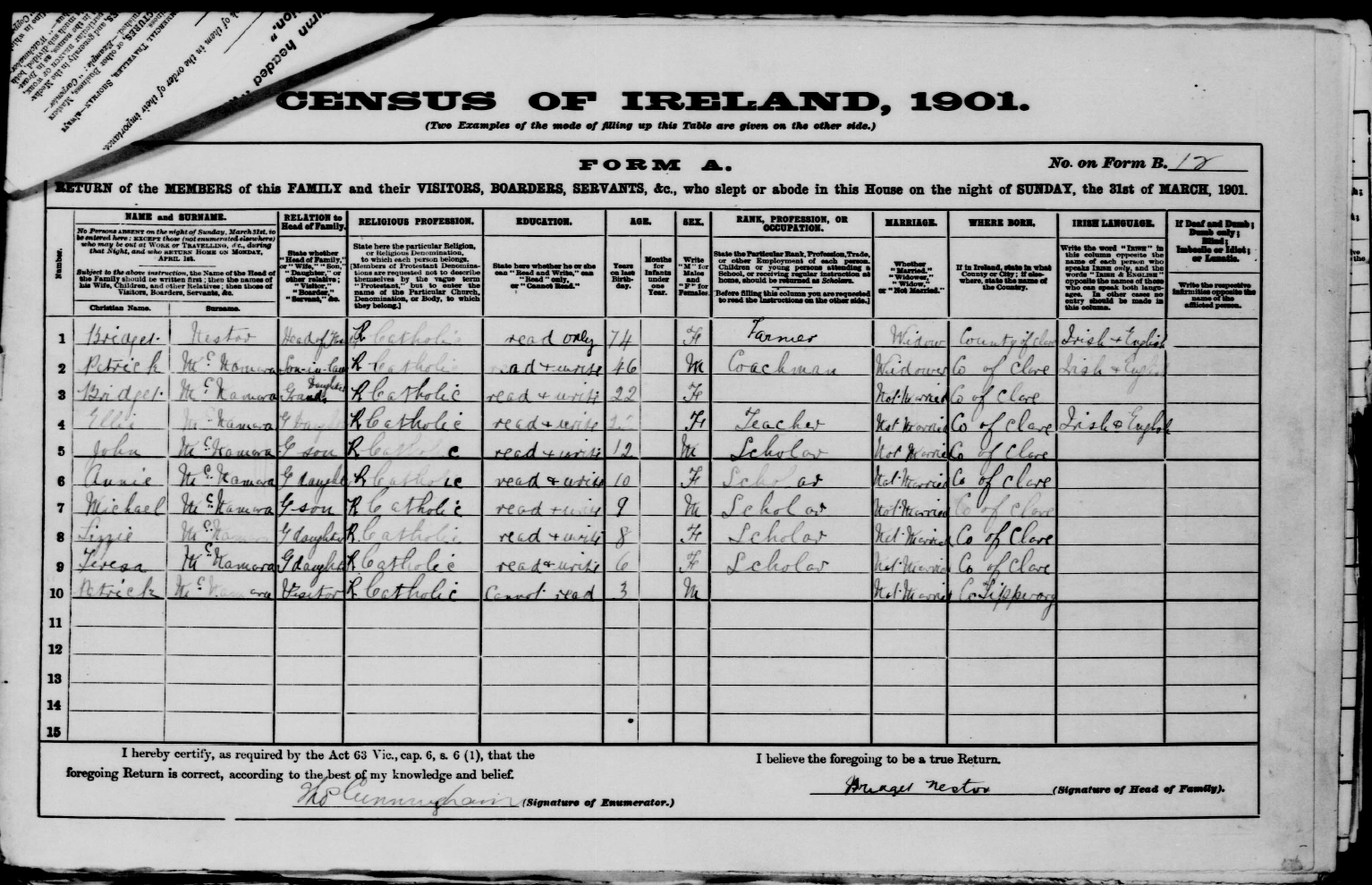
I would eventually know the boy on line five of the family’s census return, John McNamara, as “Grandpa.” Finding my family in the Irish census unlocked a vast amount of material.
One aspect of the discovery I’ll always remember was seeing the name of my grandfather’s grandmother, Bridget Nestor, listed as the head of the household. It was the first time I’d seen her name.
Assuming her listed age in 1901 was reasonably accurate, Bridget Nestor would have been born in the late 1820s. I honestly felt humbled by the realization that I was discovering a person related to me who had survived the Great Hunger, the famine that ravaged rural Ireland in the 1840s.
That meant my grandfather, whom I had known when I was a small boy, had grown up in a house with someone who had lived through that horrific time. The history suddenly seemed much less distant. That realization made me wonder about the stories my grandfather must have heard as a boy.
The census return reflected other sad events. Bridget Nestor was described as a widow. My great-grandfather, Patrick McNamara, was noted to be a widower.
My father looked over the form and recognized the names of his aunts and uncles, most of whom he’d known as a boy in New Jersey. He also noticed that two older children in the family, known to him as Uncle Pat and Aunt Minnie, were absent. The assumption was that they had already emigrated to America.
Some of the information on the census return, such as my great-grandfather being a coachman, opened up lines of inquiry. Over time, a lot of information would turn up about the 10 people living in that farmhouse in rural Ireland, down to the child on line 10, a cousin of my grandfather’s whose family lived in Tipperary.
The census return also revealed important details of geography. Determining exactly where the family lived opened up areas of research. It meant I could determine their church parish, which led to locating marriage and baptismal records. And it steered me to land records and maps, which tipped me off to the existence of Nestor’s Bridge, a nearby structure named for my great-grandmother’s family.
Incidentally, I mentioned that I first found this census record by scrolling through reels of microfilm. Before there was an online index of the 1901 Census of Ireland, that’s how it had to be done. I knew my grandfather grew up somewhere near Tulla, in County Clare, so I read all the census returns for the surrounding countryside. Eventually I recognized the right family.
Today it’s much easier. The Irish government has digitized and indexed the census records and the family’s household in 1901 is now much easier to locate.